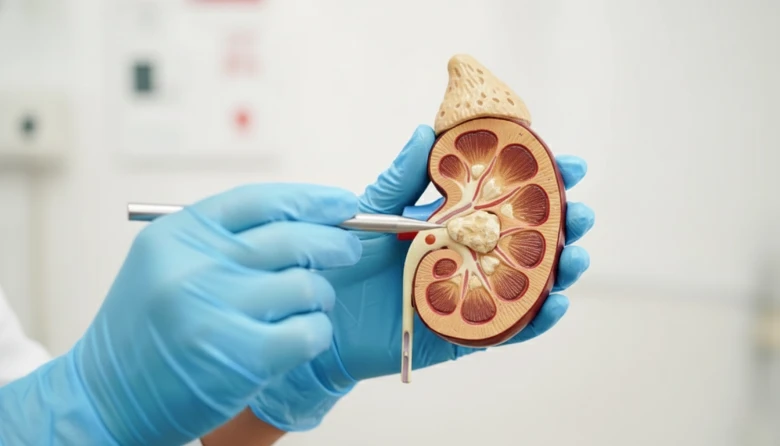
Kidney stones are a common problem that can cause severe pain and discomfort. They form when minerals and salts in the urine stick together and create hard deposits inside the kidney. While small stones often pass naturally, larger ones may need medical attention. At Sahayog Hospital, we help patients get the right diagnosis and treatment for kidney stones using advanced and minimally invasive methods.
What are kidney stones?
Your urine contains different minerals and salts. When there is too much of these substances and not enough fluid, they can come together and form small, hard stones inside your kidneys. Some stones stay in the kidney and do not cause trouble, while others move into the ureter, the narrow tube that carries urine from the kidney to the bladder. If the stone gets stuck there, it blocks the urine flow and causes sharp, intense pain.
Common symptoms of kidney stones
Kidney stones can sometimes go unnoticed if they stay in the kidney. But once they start moving, symptoms appear quickly. You may experience:
- Sharp or cramping pain in your back, side, or lower abdomen
- Pain that comes and goes as the stone moves
- Frequent urge to urinate
- Burning sensation while passing urine
- Blood in urine or urine that appears reddish or dark
- Nausea and vomiting
- In men, pain at the tip of the penis
If you experience any of these symptoms, especially severe pain or blood in your urine, it is best to visit a doctor immediately.
What causes kidney stones?
Kidney stones can form due to several reasons, including:
- Not drinking enough water: When you do not drink enough fluids, your urine becomes concentrated, which allows salts and minerals to form stones more easily.
- High-protein diet: Eating too much meat, fish, or poultry increases acid levels in your urine. This can lead to uric acid or calcium oxalate stones.
- Digestive issues: Certain bowel conditions can affect how your body absorbs nutrients, increasing the risk of stones.
- Obesity: Being overweight changes the acid balance in your urine, making it easier for stones to form.
- Medications and supplements: Some medicines and high doses of calcium or vitamin C supplements can increase your chances of developing stones.
- Family history: If someone in your family has had kidney stones, you are more likely to get them too.
How are kidney stones diagnosed?
Doctors can diagnose kidney stones through:
- X-rays: Helps spot larger stones
- Ultrasound: Safe and painless imaging test
- CT Scan: Gives a clear and detailed view of the urinary tract
At Sahayog Hospital, our urologists use modern imaging and diagnostic tools to accurately detect the size and location of kidney stones for proper treatment planning.
Treatment options for kidney stones
Treatment depends on the type, size, and location of the stone, and how severe your symptoms are. Your doctor will decide the best approach after evaluating your condition.
Letting the stone pass naturally
If the stone is small, it may pass on its own through urine. Doctors usually allow 4 to 6 weeks for this process if:
- Pain is manageable
- There is no infection or blockage
- The stone is small enough to move
During this time, drink plenty of water and take pain relief medication if needed.
Medications
Certain medicines can relax the ureter, helping the stone pass more easily.
Surgery (for larger stones)
When the stone is too large or painful to pass naturally, surgery may be needed. Most modern procedures are minimally invasive, meaning they involve very small or no cuts and allow faster recovery.
- Shock wave lithotripsy (SWL): Uses sound waves to break the stone into small pieces that pass through urine. You can usually go home the same day and return to normal activity in 2 to 3 days.
- Ureteroscopy (URS): A thin telescope called a ureteroscope is inserted through the bladder into the ureter or kidney. The stone is either removed or broken into small pieces using a laser.
- Percutaneous nephrolithotomy (PCNL): Best for large kidney stones. A small cut is made in the back to insert a scope and remove the stone. This is done under general anaesthesia.
- Other surgeries: Open or robotic surgery is used only in rare cases when other treatments do not work.
How to prevent kidney stones?
Kidney stones can come back, so prevention is important. Here are a few tips to keep them away:
- Drink at least 2 to 3 litres of water daily
- Reduce your salt intake
- Eat more fruits and vegetables
- Limit high-oxalate foods such as spinach, nuts, and chocolate
- Eat less red meat and animal protein
- Get the right amount of calcium, do not overdo or avoid it
Making these small lifestyle changes can greatly lower your chances of developing stones again.
When to see a doctor?
If you have severe pain, fever, vomiting, or notice blood in your urine, do not ignore it. These could be signs of a kidney stone or infection that needs immediate attention. The specialists at Sahayog Hospital provide complete kidney stone care, from diagnosis and medication to advanced surgical procedures, to help you recover quickly and comfortably.
Latest Blogs
A simple guide to gallstones: laparoscopic surgery, treatment and recovery tips
8th Oct, 2025
Understanding hypertension: symptoms, causes and practical tips for control
22nd Oct, 2025
Everything you need to know about laparoscopic gynaecology
29th Oct, 2025
Breathe easy again: septal and sinus surgery explained
5th Oct, 2025